



At the invitation of the Association MACAST-O Longuenesse, a student association run by students enrolled in the Professional Bachelor's Degree in Tourism and Hotel Management at the University of the Littoral Opal Coast, Qiu Shuzhen and Xu Meng, teachers from the Confucius Institute of Artois, traveled to Longuenesse on January 25, 2026, to participate in the China-themed day at the Salon of Civilisations. The Salon of Civilisations is a public initiative jointly organized by the association and the Longuenesse Municipal Cultural Office (Office Municipal de la Culture de Longuenesse), offering free access to students, faculty, and all local residents. With “China” as the 2026 theme, the two teachers presented four Chinese cultural activities for demonstration and hands-on experience: Tai Chi, ink-blowing painting, panda paper-folding, and cutting the Chinese character “春” (spring). The teachers participated in the entire event throughout the day and were invited to a celebratory party afterward. According to preliminary estimates by on-site staff, the event attracted over a thousand participants and received an enthusiastic response.
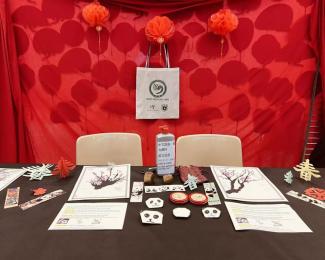
After receiving the invitation, the Confucius Institute staffs made thorough preparations. Recognizing that the primary participants of the event included college students, families with children, and retirees, we designed activities tailored to promote health across all age groups: a Tai Chi demonstration and hands-on experience, ink-blowing painting and panda paper-folding for parents and children to enjoy together, and a “Spring” Chinese character paper-cutting activity for college students to explore Chinese language. These highly interactive activities complemented the stage performances.
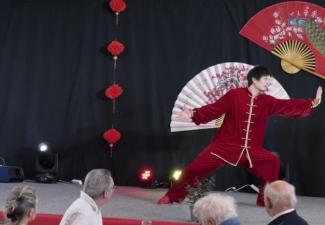
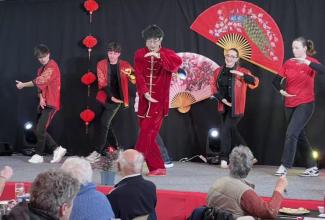
Accompanied by Chinese music, Mr. Xu Meng demonstrated Tai Chi in the center of the stage. He masterfully showcased the art's blend of strength and softness, drawing waves of applause from the audience. Following the demonstration, Mr. Xu invited local university students and residents to join him on stage for a hands-on experience. He taught them basic Tai Chi movements while counting the rhythm in Chinese numerals. Participants followed his motions to the rythme of “one, two, three, four, five, six, seven, eight.” The session concluded with Mr. Xu and the participants performing a short section of Tai Chi together, earning enthusiastic cheers from the audience.
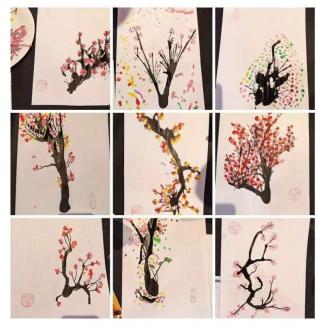
Ms. Qiu Shuzhen primarily oversaw the ink-blowing painting, paper-folding, and paper-cutting activities. The on-site demonstrations drew curious attention from university students and local residents. Ink-blowing painting proved especially popular with children. Ms. Qiu had prepared step-by-step instructions in French beforehand, allowing parents to guide their children through the process. Meanwhile, Ms. Qiu and Mr. Xu provided necessary explanations and assistance to participants. After completing their ink-blowing paintings, each participant could choose either a “Peace” or “Amongst the Plants” seal to stamp onto their work. Finally, they departed with their unique work of art, visibly pleased.
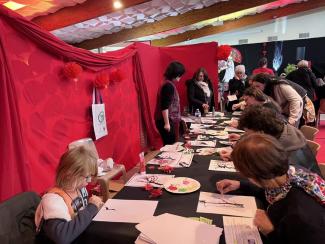
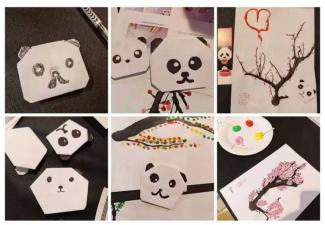
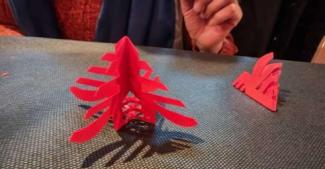
Many children returned to try panda paper-folding after experiencing ink-blowing painting. Under the guidance of the two teachers, they completed their own pandas: some were adorably cute, others with unique styles. Ms. Qiu also gave each child a panda bookmark inscribed with Spring Festival blessings, doubling their joy. Paper-cutting proved to be more challenging for children and required parental assistance. One retired lady shared her story after trying the Chinese character paper-cutting: her daughter works in China, and she planned to celebrate the Spring Festival remotely with her. She was thrilled to have cut out the character for “spring” and intended to use it to decorate her dining table.
Like the lady mentioned above, many participants have worked or studied in China, or have family there, which is why they take such a keen interest in Chinese cultural activities. Throughout the event, we observed that local residents are filled with curiosity and a desire to explore Chinese language and culture. Numerous participants greeted us and expressed their gratitude in Chinese, with “ Nǐ hǎo,” “ Xièxie,” and “ Zài jiàn” echoing throughout the venue.
To sum up, this event not only showcased and taught cultural skills but also sparked spontaneous exchanges and deep interest in the Chinese language and culture among participants, especially those with emotional ties to China. It fostered profound cultural interaction within a warm and welcoming atmosphere. The highly interactive immersive experience allowed Chinese culture to resonate deeply through tangible, hands-on, and participatory engagement, particularly sparking young people's intuitive appreciation for Eastern aesthetics and philosophy. This was not merely a cultural event organized by the Confucius Institute, but a heartfelt humanistic exchange that reached deep into the community. Through this bilateral cultural exchange, it effectively fostered dialogue and mutual learning between Chinese and French civilizations.